Original article - http://business.nikkeibp.co.jp/article/tech/20090618/197972/?P=1
Dear Respected Readers
Namaste, again!
Today I wish to introduce you an interview published on Nikkei Business Online.
The automobile industry is facing unprecedented tough time in this global recession. While GM, which had been the world’s largest car manufacturer, bankrupted, Toyota, too, has fallen in massive deficit.
In this harsh environment, though, hybrid car seems the only hope for them to expand the market.
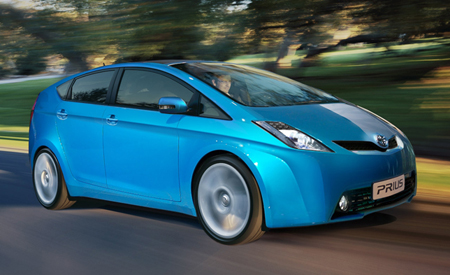
In Japan, thanks to the government support in the form of tax reduction for eco-friendly car purchase, the monthly top sales were in April, Honda’s new “Insight”, and in May, Toyota’s new “Prius”, both leading hybrid cars.
Here I would like to introduce an interview article abstracted from Nikkei Business Online, business review online magazine:
Nikkei BP (N): New “Prius”, shows favorable sales since it has been launched on 18th May. What is your view, how hybrid cars will progress in the future?
Mr. Takimoto (T): Toyota is aiming to equip hybrid car for all the models by 2020 and we are steadily approaching to the goal.
Some people consider "Hybrid cars are just mediators until battery cars would be penetrated in market", which is not Toyota’s concept.
We at Toyota are looking for sustainable mobility that can harmoniously coexist with the earth. Motors, battery and controller; these are core technologies of hybrid car and all can be utilized in the future when fuel cell cars or battery cars become commonplace. "Hybrid car" might disappear in the future, but "hybrid technology" will be essential permanently and thus we have worked hard to develop the technology.
N: Recent cars are becoming motor-driven, instead of traditional engine-driven and the technologies required to build a car is changing and extending. How far is Toyota going to develop by its own?
T: In Toyota, basically we try to develop everything in-house. We tried with commercial motor while developing the first Prius (launched in 1997), but it was not useful for a car. Durable temperature and life could not fulfill the required condition. So we started developing everything by ourselves.
However as a car maker, Toyota had lesser knowledge of battery, and to cover this weak point we established a joint company with Panasonic. It is obvious that we would save time as well if we purchase equipments from outside. But I think if we are depending on outside solution, it would be very difficult to step ahead of competitors.
At Toyota also, we have experienced too many failures that sometimes even I felt those challenges were for us to experience failures. But those failures became driving power for new development. If we were depending on other company for such development, we would never see the pain/burden behind the manufacturing of these parts.
We at Toyota need eyes to evaluate the technologies, and we can obtain the skill only when we work by ourselves (make our own hands dirty). Manuals will not give you this ability.
N: Chinese companies are start entering into the eco-car segment. For example Chinese car maker BYD launched plug-in-hybrid car which can charge the battery with household power source. However at this moment very few Japanese car makers feel the threat. What is your view?
T: I would not underestimate them. I believe Chinese car manufacturers will grow from now. They have hungry spirits that Japanese makers already lost and their immeasurable learning attitude is large threat for us. We need to keep on running, if we stop even for a moment, they would catch up us.
 インドビジネス